

A room divider curtain can create a study corner, screen a sleeping space or soften the boundary between living and dining areas. Explore the fabrics, tracks and layout details that matter in a Dhaka flat.
A room divider curtain is a flexible way to separate two areas of a flat without building a permanent wall. A ceiling-mounted curtain can screen a sleeping corner, define a workspace, or create privacy between living and dining areas. Open it, and the room becomes one space again.
It works best when you need visual separation rather than soundproofing. The fabric, track, and position all matter, especially in a Dhaka apartment where daylight, ceiling fans, and air conditioning may serve more than one area.
Before choosing a curtain, consider how the divider will affect movement, light, and everyday comfort.
Where Room Divider Curtains Work Best
A curtain partition is useful when one room serves several purposes. You can close the divider when you need privacy and draw it back when you want an open layout.
Living room and home office
A desk placed in the corner of a living room can feel exposed when other family members are nearby.
A light-filtering divider creates a visual boundary without making the workspace unnecessarily dark. Position the track so the curtain can open without blocking the desk, shelves, or electrical outlets.
Studio apartment or sleeping corner
A sleeping area usually needs more privacy than a study.
An opaque or lined curtain can screen the bed from the sitting area. If the bedroom corner receives daylight through the adjoining room, check how dark it becomes when the divider is closed.
Living and dining areas
In some Dhaka flats, the main entrance opens directly towards the dining table.
A curtain can soften that sightline while preserving the option to use both areas as one space.
Allow enough clearance for dining chairs, doors, and the main walking route. A partition that makes everyday movement awkward won't remain useful for long.
Why a Ceiling Track Usually Works Better
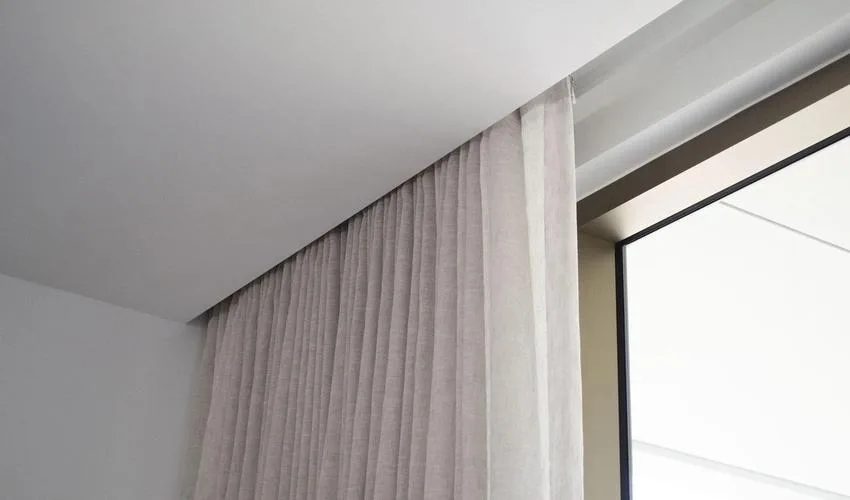
A ceiling-mounted track is generally a practical choice for a full-height room divider. It creates a continuous hanging line and allows the curtain to gather to one side when open.
Depending on the system and installation conditions, a track can run straight across a space or turn around a sleeping corner.
The track must be selected for the curtain's weight, the unsupported span and the ceiling construction.
Concrete ceilings and gypsum false ceilings
A concrete slab may support suitable curtain-track fixings when they are properly specified and installed.
A gypsum false ceiling needs particular care. The gypsum board itself shouldn't be assumed capable of supporting a heavy curtain that will be opened and closed frequently.
The installer must assess whether structural backing or another suitable fixing arrangement is required.
Plan where the curtain goes when open
Think about where the fabric will gather.
Even a beautifully made curtain can obstruct furniture or a doorway when its stacking space hasn't been considered.
Decide whether the curtain should open to the left, right, or both sides before finalising the track position.
How a Room Divider Affects Airflow and Daylight
In many Dhaka apartments, a ceiling fan or split air conditioner serves an open living area. A curtain divider changes how air moves through that space.
Light fabric may billow when a fan is operating. Keep the curtain and its track safely clear of fan blades and other moving equipment.
Weighted hems can help a curtain hang neatly, but they do not make an unsafe position acceptable.
Will the other side still receive air conditioning?
A dense curtain can restrict cooled air from reaching the other side of a room.
Sheer or more open fabrics generally allow greater air movement, but that doesn't guarantee equal cooling.
If one area relies entirely on the AC unit in the adjoining space, consider whether the divider needs to remain partly open.
What about natural light?
Some Dhaka flats have windows along only one external wall. The inner part of the room may already receive limited daylight.
A heavy divider could make that area noticeably darker.
For spaces where daylight matters more than privacy, a sheer or partially open divider may be the better choice.
Which Fabric Is Best for a Room Divider Curtain?
The best fabric depends on how much privacy you need, how daylight enters the room, and whether both sides of the curtain will be visible.

Feature | Sheer curtain | Opaque or lined curtain |
|---|---|---|
Daylight | Allows more light through | Reduces light passing between spaces |
Visual privacy | Partial, depending on lighting | Greater when fully closed |
Air movement | Generally less restrictive | May restrict airflow |
Appearance | Soft, open separation | Stronger visual boundary |
Sound | Limited absorption | May absorb some reflections |
Best suited to | Study corners and living areas | Sleeping spaces and visual screening |
Choose sheer for daylight and visual zoning
A sheer room divider introduces separation while keeping the interior connected.
It can work well in a deep-plan apartment where the space behind the curtain depends on daylight from the living room.
Explore Hello Sun's sheer curtain collection for different light-filtering fabrics and finishes.
Remember that sheer fabric doesn't provide complete visual privacy, especially when lighting differs on either side.
Choose an opaque fabric for greater privacy
An opaque fabric is more suitable when you want to screen a bed, wardrobe or workspace from view.
A lining may improve visual coverage, but it also adds weight and can change how the fabric looks on the reverse side.
The track should be specified for the finished curtain, including its lining and heading.
Do heavier curtains soundproof a space?
No. Dense curtain fabrics can absorb some sound reflections, but they cannot provide the sound isolation of a properly constructed partition.
Hello Sun's acoustic curtain collection covers heavier fabrics designed for sound absorption.
You can also read acoustic curtains for noisy Dhaka flats to understand their limitations. That guide focuses on window-related noise, which is different from sound travelling between areas of the same room.
A Room Divider Must Look Finished From Both Sides
Unlike a window curtain, a room divider may be visible from both adjoining areas.
A decorative fabric can look beautiful from the living room while showing an unattractive reverse, exposed backing or visible lining from the other side.
Double-faced fabrics, suitable plain weaves, and carefully finished linings can create a more balanced result.
The heading also affects the appearance. Regular folds may give the divider a structured look from either direction when the track and heading are compatible.
Before confirming the fabric, examine a hanging sample from both sides and under different lighting conditions.

When Should You Avoid Using a Curtain as a Partition?
A curtain divider isn't suitable for every space.
When you need sound isolation: A curtain will not provide the acoustic privacy of a properly designed solid partition.
When airflow is already limited: A heavy divider may make the enclosed area uncomfortable.
When the ceiling lacks suitable support: The track installation must be assessed before fabric is ordered.
Near cooking appliances: Keep curtains safely away from heat, grease, open flames, and cooking equipment.
Across essential walking or exit routes: Choose a position that doesn't create an obstruction.
Sometimes moving the partition line or choosing another type of divider is more practical than changing the fabric.
Try the Room Divider Position Before Ordering
Before choosing the curtain, mark its proposed position on the floor with removable tape.
Walk around the room. Pull out the dining chairs, open nearby doors, and check whether people can move comfortably.
Look at the line from both sides and consider how the furniture will sit when the divider is closed.
Check these details before finalising the layout:
Will both areas receive enough daylight?
Is the proposed curtain safely clear of the ceiling fan?
Will closing it interfere with air conditioning?
Can people move through the room comfortably?
Where will the curtain gather when open?
Will the fabric look finished from both sides?
Can the proposed ceiling and track safely support the curtain?
This simple test may reveal an awkward position before any material is cut or hardware installed.
Discuss Your Room Layout With Hello Sun
Hello Sun provides bespoke curtain fabrics, hanging systems and made-to-measure window treatments in Dhaka.
A consultation begins with understanding the room, discussing fabric options and assessing the installation requirements. Technicians measure windows on site before approved curtain specifications move into production.
For a proposed room divider, the team would need to confirm whether the intended application, ceiling construction, and track requirements are suitable and fall within the services available.
Bring photographs of the room, approximate dimensions, and the proposed partition position. A floor plan can be useful if the divider needs to work around furniture or doorways.
You can also explore Hello Sun's completed projects for examples of its window-treatment work.
To discuss suitable materials and confirm whether your proposed divider can be accommodated, visit the Hello Sun contact page.